
The Insect Reproductive System is one of the most efficient and evolutionarily refined biological systems in the animal kingdom, enabling insects to reproduce rapidly and maintain their dominance across nearly every ecological niche on Earth. From tropical rainforests and agricultural fields to deserts and urban environments, insects have successfully adapted to a wide range of habitats, and this success is largely driven by the flexibility and efficiency of their reproductive mechanisms. The ability of a single female insect to produce hundreds or even thousands of offspring during her lifetime highlights the remarkable productivity of this system.
Unlike vertebrates, which generally possess relatively consistent reproductive structures, the Insect Reproductive System exhibits extraordinary diversity in both morphology and physiological processes. This diversity is the result of millions of years of evolutionary adaptation, during which insects modified their reproductive strategies to align with environmental pressures, feeding habits, and ecological roles. As a result, different insect species display highly specialized reproductive structures and mechanisms that maximize reproductive success while minimizing energy expenditure and environmental risk.
Recent advancements in entomology and molecular biology have revealed that the Insect Reproductive System is not merely a structural arrangement of organs but a highly dynamic system regulated by hormones, genetic expression, and biochemical signaling pathways. Interactions between male and female reproductive components involve complex processes such as sperm competition, chemical manipulation, and behavioral coordination, transforming reproduction into a strategic and highly optimized biological function that ensures long-term survival and adaptability.
Architectural Blueprint of Insect Reproductive Anatomy
The Insect Reproductive System originates during early embryonic development when specialized pole cells are formed and migrate toward the posterior abdominal segments, where they differentiate into gonads that later develop into testes in males and ovaries in females, and within these gonads gametogenesis begins through tightly regulated processes of mitosis and meiosis that ensure the production of viable and genetically diverse gametes, while the entire reproductive system is strategically positioned within the 8th and 9th abdominal segments to maintain structural balance and protect delicate reproductive tissues, and this positioning also ensures that insects can maintain mobility and flight efficiency even when carrying developing eggs, and the internal organization of the system consists of paired gonads connected to a network of ducts that converge at the gonopore, allowing efficient transport and release of reproductive materials, and this entire architecture is closely integrated with hormonal and environmental signals such as temperature, nutrition, and seasonal cycles, ensuring that reproductive processes are activated only under favorable conditions, thereby enhancing survival and reproductive success across diverse ecological environments.
Sclerotized Terminalia: The Lock-and-Key Mechanism
The Insect Reproductive System includes highly specialized external genital structures known as terminalia, which are heavily sclerotized to provide strength, durability, and precision during mating, and these structures vary significantly between species, forming the basis of the lock-and-key mechanism in which successful copulation can only occur if the male and female genitalia match perfectly, thereby preventing interspecies mating and maintaining genetic integrity within populations, and this mechanism plays a crucial role in evolutionary processes by reinforcing reproductive isolation and promoting speciation, while also serving as one of the most reliable tools in entomological taxonomy because terminalia show minimal variation within species but significant differences between species, allowing researchers to accurately identify and classify insects, and in addition to their role in mating compatibility, these structures also contribute to mechanical efficiency during copulation, ensuring proper alignment and effective sperm transfer even in challenging environmental conditions.
The Male Insect Reproductive System: Production and Transfer
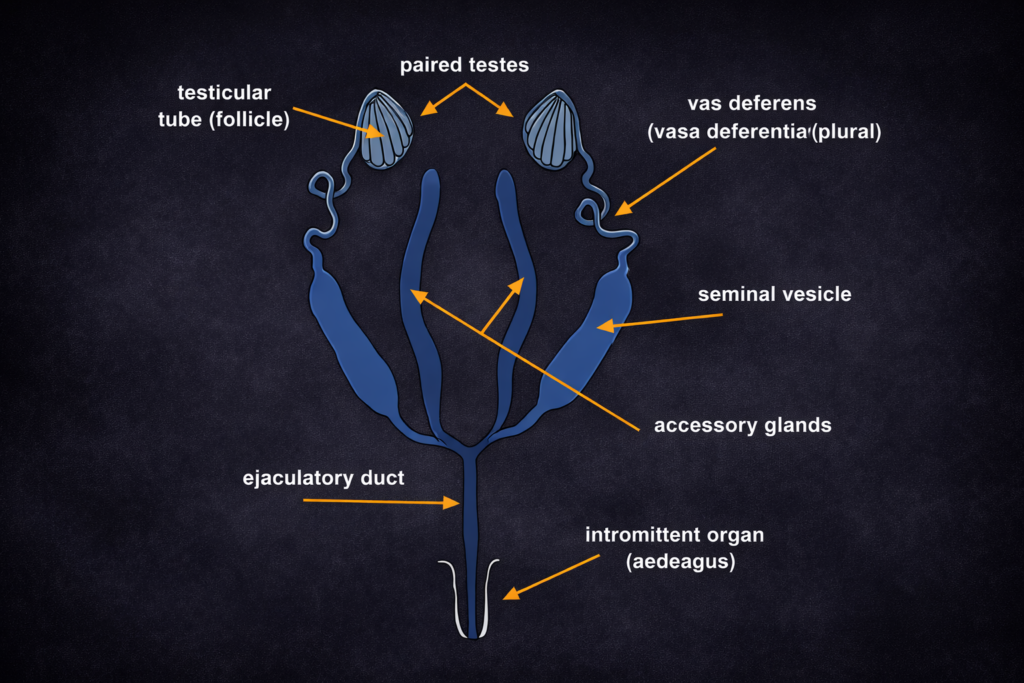
The male Insect Reproductive System is designed to maximize reproductive efficiency through the rapid production, maturation, storage, and transfer of sperm, beginning with paired testes that are composed of numerous tubular follicles where spermatogenesis occurs through sequential stages of mitosis and meiosis, resulting in the formation of genetically diverse sperm cells that are supported by cyst cells providing nourishment and structural stability, and once formed these sperm cells move into the vas deferens, a transport tube that facilitates their movement toward the reproductive opening, often expanding into a seminal vesicle where sperm are stored and undergo final maturation, enabling males to engage in multiple mating events without delay, while accessory glands play a critical role by producing seminal fluids containing proteins and biochemical compounds that not only protect and nourish sperm but also influence female reproductive behavior by increasing egg-laying rates and reducing the likelihood of remating, and the transfer of sperm is achieved through specialized structures such as the aedeagus and, in some species, the endophallus, which ensure precise delivery into the female reproductive tract, and the efficiency of this system can be summarized as:
- Continuous and high-volume sperm production within follicles
- Temporary storage in seminal vesicles for repeated mating
- Biochemical enhancement of reproductive success through accessory glands
- Precise and targeted sperm delivery via specialized copulatory organs
The Female Insect Reproductive System: Development and Storage
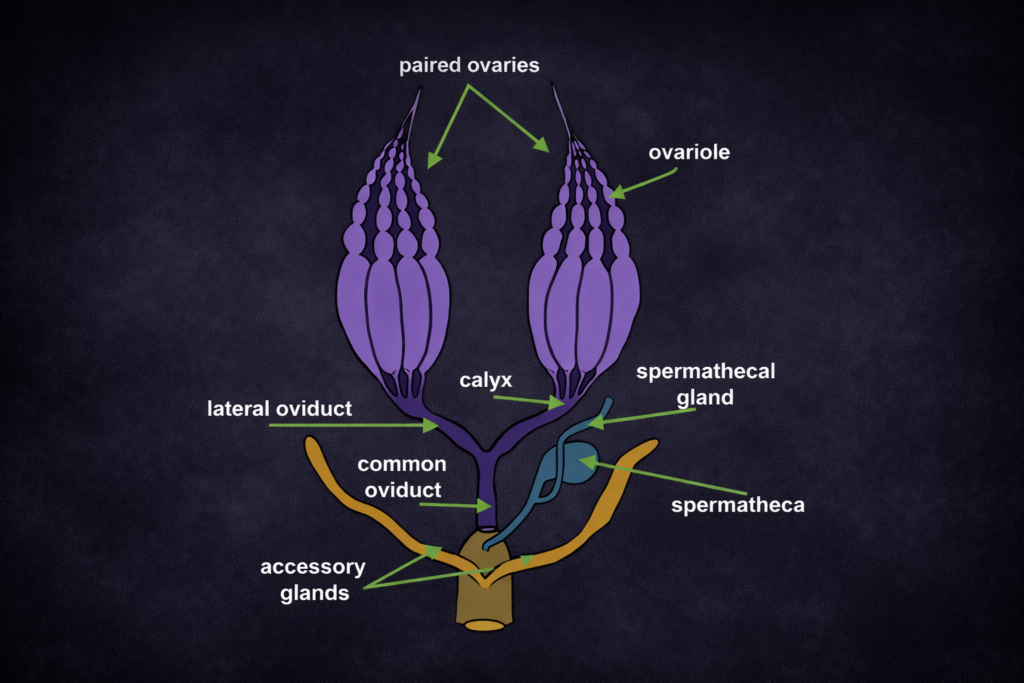
The female Insect Reproductive System is highly complex and functionally advanced, as it is responsible not only for producing eggs but also for ensuring their proper development, fertilization, and survival, with paired ovaries composed of multiple ovarioles that serve as independent units of egg production, where panoistic ovarioles lack nurse cells and produce eggs at a slower rate while meroistic ovarioles contain nurse cells known as trophocytes that provide nutrients and enable rapid egg development, and a critical stage known as vitellogenesis involves the synthesis of yolk proteins in the fat body which are transported to developing eggs under hormonal control, requiring significant energy input and often depending on nutrient-rich diets, while the spermatheca serves as a specialized storage organ that allows females to retain viable sperm for extended periods and control its release during fertilization, giving them the ability to optimize reproductive timing and ensure that eggs are fertilized under favorable environmental conditions, and the functional advantages of this system include:
- High egg production through multiple ovarioles
- Efficient nutrient allocation during vitellogenesis
- Long-term sperm storage enabling reproductive flexibility
- Controlled fertilization to maximize offspring survival
Advanced Reproductive Strategies in Insects
The Insect Reproductive System supports a wide variety of reproductive strategies that enhance adaptability and survival across different environments, including both sexual reproduction and parthenogenesis, where females can produce offspring without fertilization, allowing rapid population growth in stable environments or in situations where males are scarce, while also supporting different reproductive modes such as oviparity where eggs are laid externally and develop outside the mother’s body, ovoviviparity where eggs hatch داخل the female before being released, and viviparity where offspring develop داخل the female and receive direct nourishment, and these strategies provide insects with the flexibility to respond to environmental pressures, reduce mortality rates of offspring, and maintain population stability even under challenging conditions, and the key reproductive strategies include:
- Sexual reproduction for genetic diversity
- Parthenogenesis for rapid population expansion
- Oviparity for widespread egg distribution
- Ovoviviparity and viviparity for increased offspring protection
Fertilization Process and Oviposition Mechanics
Fertilization in the Insect Reproductive System is a highly controlled internal process where sperm stored in the spermatheca are released in small quantities as eggs pass through the reproductive tract and enter the egg through a microscopic opening known as the micropyle, ensuring precise fertilization and efficient use of sperm, while the ovipositor functions as a specialized egg-laying structure composed of multiple valvulae that work together to deposit eggs in suitable environments such as soil, plant tissues, or host organisms, and this structure varies in design depending on species requirements, allowing for drilling, piercing, or insertion, thereby ensuring that eggs are placed in environments that maximize survival and development, and the effectiveness of this process is supported by:
- Controlled release of sperm for precise fertilization
- Micropyle-mediated entry ensuring successful fusion of gametes
- Adaptable ovipositor structures for diverse environments
- Strategic egg placement to enhance offspring survival
Pheromones and Courtship Behavior
The Insect Reproductive System is closely integrated with behavioral and chemical communication systems, where pheromones act as powerful signaling molecules that enable insects to locate mates over long distances, facilitate species recognition, and synchronize reproductive activities, while courtship behaviors such as acoustic signaling, visual displays, and the exchange of nuptial gifts ensure compatibility and readiness for mating, and these behaviors are regulated by the endocrine system which coordinates reproductive timing with environmental factors such as temperature, light, and resource availability, ensuring that mating occurs under optimal conditions, and the effectiveness of these interactions can be summarized as:
- Pheromones enabling long-distance mate attraction
- Courtship behaviors ensuring mating success
- Hormonal regulation aligning reproduction with environment
- Species-specific communication preventing mismating
Conclusion
The Insect Reproductive System is a highly sophisticated and evolutionarily optimized biological system that integrates structural precision, biochemical regulation, and adaptive reproductive strategies to ensure survival, efficiency, and ecological dominance across diverse environments, making it a fundamental area of study in modern biology with significant implications for agriculture, pest management, and environmental sustainability.
FAQs: Insect Reproductive System
What is the spermatheca?
It stores sperm and allows controlled fertilization.
How does the Insect Reproductive System produce many eggs?
Through multiple ovarioles working simultaneously.
Why are accessory glands important?
They enhance fertilization and influence female behavior.
Do all insects reproduce the same way?
No, they use multiple strategies like oviparity and parthenogenesis.
What is the ovipositor?
A structure used for precise egg-laying.


